
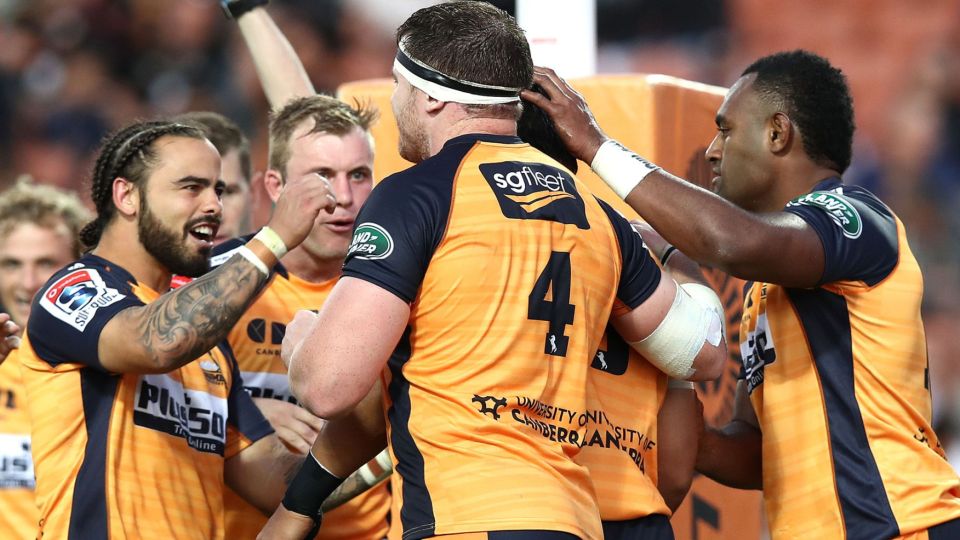
The Brumbies might be based in Australia’s capital, Canberra, but the majority of their players are from other parts of the country. While Canberra is a rugby town, it is not one of the two largest nurseries, which are Sydney and Brisbane.
Canberra (or the ACT) is a small territory in the Southern Highlands of NSW and is a federal territory, not part of NSW, created especially in 1911 to be the seat of federal government, after the Australian states federated in 1901. So, it is completely landlocked in NSW, in much the same way that Washington DC is surrounded by Maryland and Virginia.
It was completely designed and master-planned by an American architect, Walter Burley Griffin, who won an international design contest to earn the right –the city’s lake is named after him, Lake Burley Griffin.
The Brumbies organization, ACT Rugby Union, administers the whole of southern NSW from just south of Nowra all the way to the border -an area known as Southern Inland- and the Monaro region, which also means that, in the juniors, there are great trips to fantastic regional towns like Jindabyne to play the Bushpigs, Broulee (the Dolphins), Bungendore (“the Mudchooks”), Cooma, Goulburn, and Yass (with the obligatory stop off at the Murrumbatemen wineries on the way home).
Still, to understand that necessitates an understanding of their history as well as the game’s within the country.
The Game Commences
Rugby got underway in Australia around 1850 and most of the action was in Sydney and Brisbane. Although it has been played in every state since then, it only ever established itself in any meaningful way in the two largest eastern cities, Sydney and Brisbane.
The Sydney club competition got underway in the 1890s and 1884 in Brisbane, but neither played for a trophy until 1899.
In Sydney, they play for the Shute Shield, and in Brisbane, the Hospital Cup. Club rugby is still an amateur competition and a vital backbone of the grassroots of the sport, though the professional players all take part when they are not picked to play Super Rugby or National Rugby Championship (the provincial city-based competition, one tier below Super Rugby).
Canberra, by comparison, is a minnow and the club competition, the John I Dent Cup, only started in 1938. Any players that had national aspirations in those days, would probably have moved to Sydney to try their chances.
By 1995, rugby had gone professional. There was already a Super 10 competition involving four teams from South Africa, four from New Zealand, and two from Australia (NSW and Queensland).
It was the private schools that were the keepers of the flame, given that the “working classes” largely defected to the other code, rugby league, which had professionalized back in 1907. That is the reason that the Australian Schools Rugby Union has a powerful voice in the overall fabric of Australian Rugby. For many years, the schools’ rugby system was the main pathway to representative honors, and in the amateur days, there was always a healthy sprinkling of doctors, lawyers, and other professionals in the Wallabies. These days that is not the case.
A Fractured Code
Rugby in Australia, it should also be noted, contends with a domestically unique challenge of fighting for space and talent among a crowded field of football codes. Rugby Union fights an uphill battle against the likes of Aussie rules football, rugby league, and football (soccer).
Most of Australia adopts the peculiarly Australian game, Australian football, which is colloquially referred to as ‘Aussie rules’. It is played on a truly oval-shaped field with 18 to a team where everybody runs around in circles and the idea is to punt-kick the ball between a set of four vertical posts.
The main difference between league and union in the early days was that league dispensed with the two wing forwards and was, and still is, a 13-man game. Over the ensuing years up until the present, that game has gone through so many rule changes that the two codes are now vastly different games, to play, to watch and to understand.
For a country of about 24 million, imagine if there was only one code –the New Zealand All Blacks would struggle to beat the Wallabies, more often than not. Sadly, that will never happen as rugby union is the poor cousin.
The Genesis of the Brumbies
A couple of years prior to professionalization, Canberra entered a team in the powerful Sydney Shute Shield amateur club competition, known as the Kookaburras. Lo and behold, some no names, at the time, such as George Gregan, Joe Roff, Rod Kafer, Stephen Larkham, Murray Harley, Marco Caputo, and others (who all went on to play for the Wallabies), showed up the Sydney teams.
The Sydney and Brisbane club competitions always considered themselves the elite. Sydney and Canberra are three hours apart by road, and the Sydney teams did not like the travel that they were not used to, so the year after Super Rugby started, the Kookaburras was no more, but formed the core of the Brumbies when Super 15 Rugby kicked off in 1996.
However, without enough local talent in Canberra to support a fully professional organization, the Brumbies recruited out of Sydney and Brisbane. The guys who came down from Brisbane and Sydney were regarded as fringe players or journeymen in their own states who would never be good enough to play for the likes of the Waratahs or Reds.
Success Forged in Team Culture
To piece together this fledgling side, they grabbed a master coach, Rod MacQueen, who had a pretty good track record. The lads all came down to Canberra, and the non-locals were all housed in a condo, provided by a sponsor, in a part of Canberra, known as Manuka, which has a real village feel to it.
MacQueen was also responsible for the team’s logo - the Brumby, which is the fearless wild horse that roams wild in packs in the Alpine country south of Canberra.

The players lived together, enjoyed a siege mentality together, got out and about the streets and coffee shops of Manuka, and made themselves great friends of the local populace. They were very quickly adopted by the locals and the wider community, so much so that they often got the prime “real estate” on the back page of the Canberra Times and forced the (rugby league) Raiders off it, but there is no less love for the Raiders because in a ‘one team’ town with both codes, most people supported both.
All of those interstaters lived in one apartment block in Manuka, the Oakton Apartments, known affectionately as “Melrose Place” and trained nearby at a suburban ground in Griffith that was open to anyone. They have since moved to the University of Canberra, which is adjacent to the Australian Institute of Sport, a world-class training facility for Australia’s elite sportspeople.
But most importantly, these also-rans won games by playing hugely entertaining rugby under MacQueen, a master tactician and, most importantly, an innovator.
They quickly established the “Brumbies culture” which exists to this day; they still recruit intelligently from interstate, often stealing young, genius players out from under the noses of the “experts who know these things” in Queensland and New South Wales. Every interstate player comes to Canberra for a chance and the tight-knit community takes them in. But, in recent times there is more homegrown talent coming through.
The Brumbies have not forgotten the grassroots, however. Squad players not picked in the matchday 23 are all required to play for their local clubs, which is a move that former coach, Jake White instituted so the local John I Dent Shield club competition is laced with Brumbies and academy players, most of whom, would once drive to Sydney on Fridays to play for Sydney clubs. Jake adopted the simple expedient of making Fridays the high-performance testing day so that players had to stay in Canberra and play for the local clubs on Saturdays if they weren’t selected.
They play an attractive brand of Rugby and they win more than any of the other Australian franchises. In their second year in 1997, they played the Auckland Blues in the final and have since gone on to win two titles.
Current England coach Eddie Jones has coached them, as has South African master coach Jake White, and latterly homegrown Wallabies hero Stephen Larkham. The current coach, Dan McKellar, is carrying on the tradition and they are a tight group, as you can see from their results.
As this goes to press, the Brumbies lead the Australian Conference with the annual grudge match with the Waratahs from Sydney due up this weekend.