
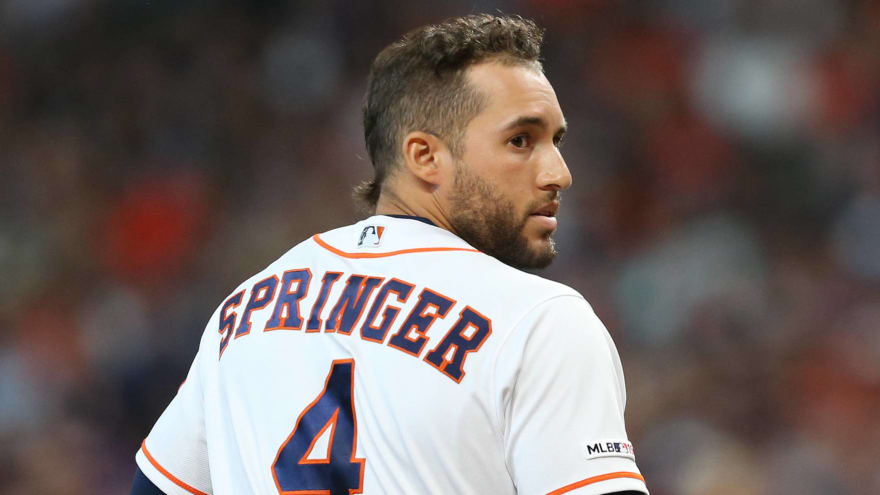
“We’ve discussed a lot of things between me and my representation.” Houston Astros center fielder George Springer was explaining to the Houston Chronicle his current contract situation last month. “It’s way too early to make that decision.”
Really? Springer, arguably the team’s most popular player, and certainly its lineup spark plug, made these comments February 17. March 9 wasn’t too early, though, for the Milwaukee Brewers to tie up Christian Yelich in a pretty blue and gold ribbon, while adding a multi-million dollar bow.
What makes Yelich’s Brew Crew deal eye-opening, though, is the Brewers’ creative pact to pay the consistently productive outfielder until he’s 50, deferring his annual payments over the next 22 years.
Springer’s current ‘Stro deal has him tethered through 2020 for $21 million, after which the three-time All-Star will join fellow outfielders Josh Reddick and Michael Brantley in basking around the free agent pool.
The specter of these three vacating the Minute Maid Park outfield next fall, en masse, is a possibility Astros fans need to prepare themselves for.
The 33-year-old Reddick’s underwhelming performance the last couple years, coupled with his heavy $13 million checkbook burden likely sees him gone. Brantley, who turns 33 in May, has been more than consistent and productive, but re-signing him will involve more team-related factors, including prospect readiness and payroll projections for owner Jim Crane.
Springer, much like Jose Altuve (inked through 2024 on a seven-year extension signed in 2018 for $163.5 million), is a home-grown superstar and can easily be seen as a career-long Astro.
For that matter, those two offensive juggernauts remind many fans of the “Killer B” duo that spanned nearly three decades together, Hall-of-Famers Craig Biggio (1988-2007) and Jeff Bagwell (1991-2005).
Great Minds…
If the Astros have any desire to wrap up Springer accordingly, the Yelich deal may provide a little nudge for them in that direction, as well as providing the necessary framework, newly ripe for appropriation.
The man who engineered the Brewers’ 2018 acquisition of Yelich is also the Milwaukee GM who sewed together this creative salary allocation. David Stearns was former Astros’ GM Jeff Luhnow’s assistant GM for just shy of three years until September 2015.
Astros owner Crane, who hired Luhnow in 2011, knows well the mind and financial acumen of Stearns, and could do much worse than lift a bit of this Brewer/Yelich agreement for a potential deferral pact with Springer, Houston’s first-round draft pick in 2011.
The Yelich Model
Yelich’s $215 million, nine-year contract with his team calls for the Brewers to defer $4 million each year from his $26 million annual salary from 2022 to 2028. The deal includes a $20 million mutual option for 2029 with a $6.5 million buyout and $2 million of the buyout would be deferred.
The two-time All-Star’s new deal includes salaries of $12.5 million for this year and $14 million in 2021, the same as in the last two guaranteed seasons of the nearly $49.6 million, seven-year contract he signed in March 2015 while with the Miami Marlins. None of that money will be deferred.
Nothing about Yelich’s deal hints at his being ball-and-chained to the Brewers’ organization through 2042. It simply means that he’ll be a retired 51-year-old with what could be called a Milwaukee “pension” of sorts, with the Brewers having spent those years investing his annual salaries, rather than leaving that to the player.
Springer Bringer?
This all contrasts, it should be emphasized, with the agreement the Astros have had for years, now, with both Bidge and Baggy as paid consultants, appearing during Spring Training every year to act as coaches to Houston’s players (among other activities during the year).
Assuming Springer even wants to be a lifelong Astro, he could agree to work with Crane and new GM James Click, on either a long-term, deferred extension similar to Yelich’s or pull the trigger on a deal that includes a consultant element that keeps him with the team to help guide future youngsters. That is, if either party wants to think that far ahead.
Or, Springer may have testing the free agent waters tucked neatly into his back pocket, a notion that would leave many, if not most, Astro fans in shock and disappointment.
Lay-Up or Long Shot?
In January, according to the Chronicle, Crane said he had “made it clear” to Springer and his agents (Excel Sports Management) that the team hoped to work out a long-term deal. The team side-stepped an arbitration hearing with Springer in the offseason, settling on his one-year, $21 million deal.
“The fans have been great to me my whole career in Houston,” Springer said mid-February with unsurprising diplomacy, leaving enough of a crack, though, to squeeze through should he desire.
“The city has been great to me. I’ve grown up as an adult there, I guess. I’ve been in this organization since I was 21 years old. This organization has been very special to me, but time will tell.”
Houston’s Rockets fans will notice this was nowhere near a slam dunk. The city’s Astros fans may be trying to picture just who might be in center field next year.